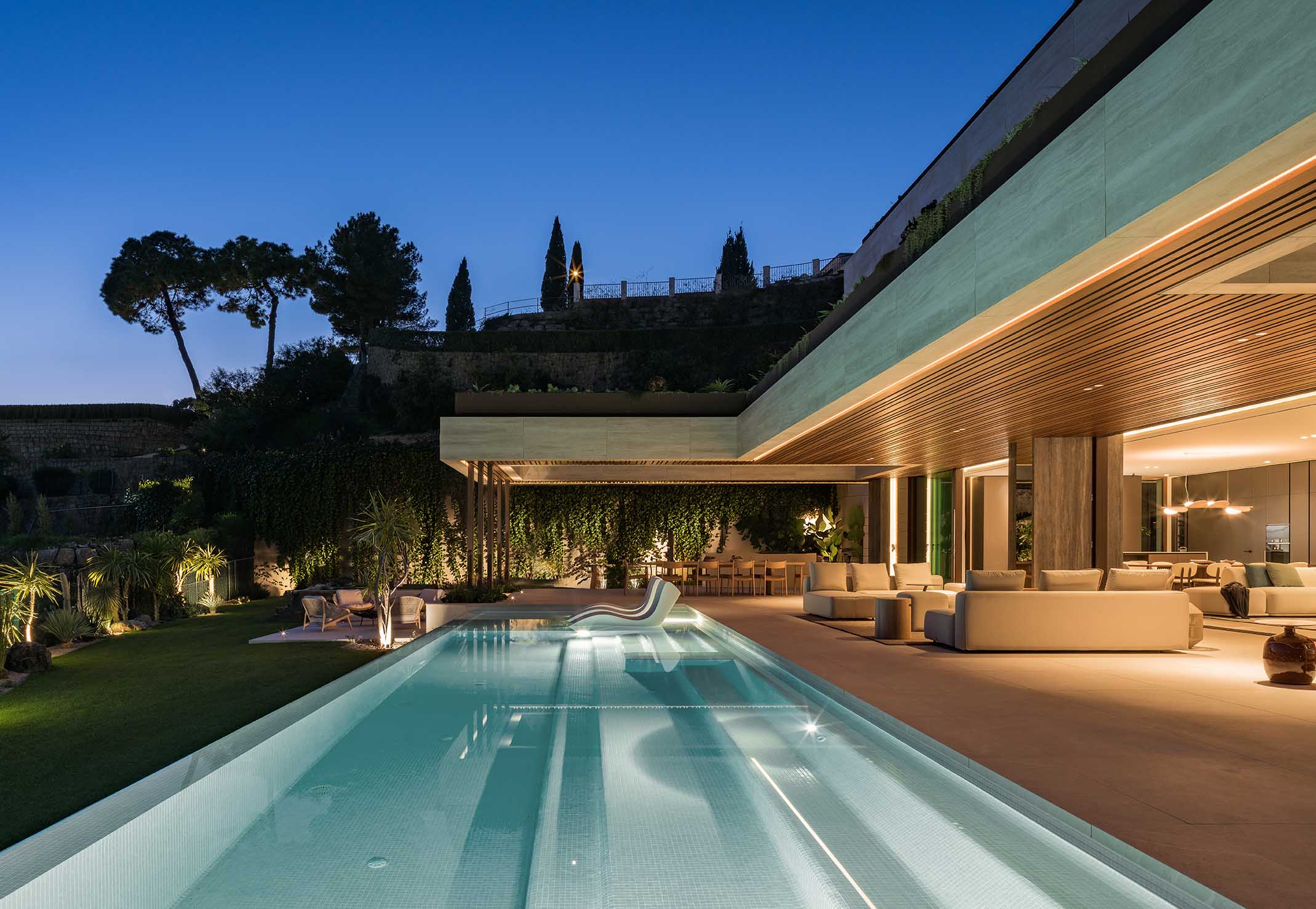
A benchmark in high-end residential development in Marbella and the Costa del Sol, Manuel Burgos Arquitectos has built a trajectory marked by sensitivity to the environment, architectural quality, and a demanding vision for detail. Gunni & Trentino and Manuel Burgos Arquitectos have maintained a consolidated collaboration for years, based on trust, technical excellence, and the search for tailored solutions for high-end residential projects. This relationship has once again materialized in The Sky Marbella, a recently completed project that reflects the value of working with specialized partners.
With over four decades of experience in Marbella, Manuel Burgos Arquitectos has developed numerous high-end residential projects. From your experience, how has the approach to large-scale residential projects on the Costa del Sol evolved?
The evolution has been very clear. In the 1980s, Marbella was mainly understood as a holiday destination, and homes were designed for short stays, with more compartmentalized spaces and a more pronounced separation between interior and exterior.
The big change came after 2008, when homes began to be conceived for longer stays and with a much more integrated approach. The kitchen became part of the main areas, technology was incorporated globally, and the relationship with the outdoors became much more fluid. From then on, residential architecture on the Costa del Sol has evolved towards more open, connected spaces adapted to a new way of living.

Marbella has established itself as
one of the most active luxury residential markets in the Mediterranean. How would you describe the profile of the international client who buys or invests in this type of project today?
There is no single profile today. The market has diversified, and there are clients who seek contemporary architecture alongside others who still value a more traditional or Mediterranean style. However, there are 80 common factors: security, location, views, quality of materials, technology, and services. From there, each client interprets luxury according to their lifestyle. Marbella also stands out for the diversity of its international public, which in recent years has expanded with new markets such as the American one.
In this context, what factors are currently priorities for developers and buyers when developing a high-end residential project: layout, equipment, finishes, services...?
Today, the priority is the overall quality of the project. Distribution must be fluid and functional, equipment must meet a high standard, and finishes must convey solidity and durability. Interior design must create a common thread throughout the home, ensuring that materials, lighting, and furniture maintain a consistent narrative. Added to this are technological integration, the relationship with the exterior, and the range of services. In this segment, quality depends on all elements being well-resolved and coherent with each other.
The Sky Marbella is an example
of large-scale residential development.
From the studio's point of view, what are the main challenges when designing and coordinating a project of this magnitude?
The main challenge is to align design, cost, and viability from the outset. In projects of this scale, it is crucial to work in a coordinated manner with all stakeholders from the early stages. In The Sky Marbella, furthermore, the plot offered exceptional conditions that demanded architecture closely linked to the landscape. The objective has been to generate a natural connection between interior and exterior, where the surroundings become an active part of the home.
In this type of project, numerous technical and equipment elements are involved that must meet a high standard and remain coherent throughout the development. How does the studio organize itself to coordinate all these decisions within the project?
The key lies in a global vision of the project. It is not about resolving each element independently, but about integrating them within a common logic of architecture, cost, and quality. Working from early stages with specialized collaborators like Gunni & Trentino allows for a cross-sectional analysis of the project, guaranteeing a coherent and homogeneous result.

In high-end residential contract projects, the property's fittings and fixtures—kitchens, bathrooms, carpentry, wardrobes, cladding, furniture, lighting, art, and styling—have a direct impact on the project's final quality. From your experience, what value does it add to have a partner like Gunni & Trentino capable of coordinating all these solutions in an integrated way?
It provides confidence and the ability to materialize. In this type of project, luxury must be conveyed even before the home is finished, and that demands credibility. Having a partner like Gunni & Trentino allows us to accompany the client, show solutions, and guarantee consistency in the result. In addition, it facilitates personalization and reinforces the perception of quality of the project.
When a specialized partner like Gunni & Trentino is incorporated from the early stages of a project, how does it change the development and decision-making process within the architectural studio?
It allows for more consistent decision-making from the outset. The project is no longer approached in a fragmented way and is instead analyzed transversally. This improves coordination between disciplines, better adjusts the project to its objectives, and reinforces the quality of the final result.
Beyond the constructed projects, what legacy do you consider most important to leave in high-end residential development?
Good craftsmanship. The idea of developing projects with rigor, attention to detail, and solutions that age well. Architecture must integrate with its surroundings and evolve over time. There is no greater value than a project that, years later, still conveys quality and coherence.